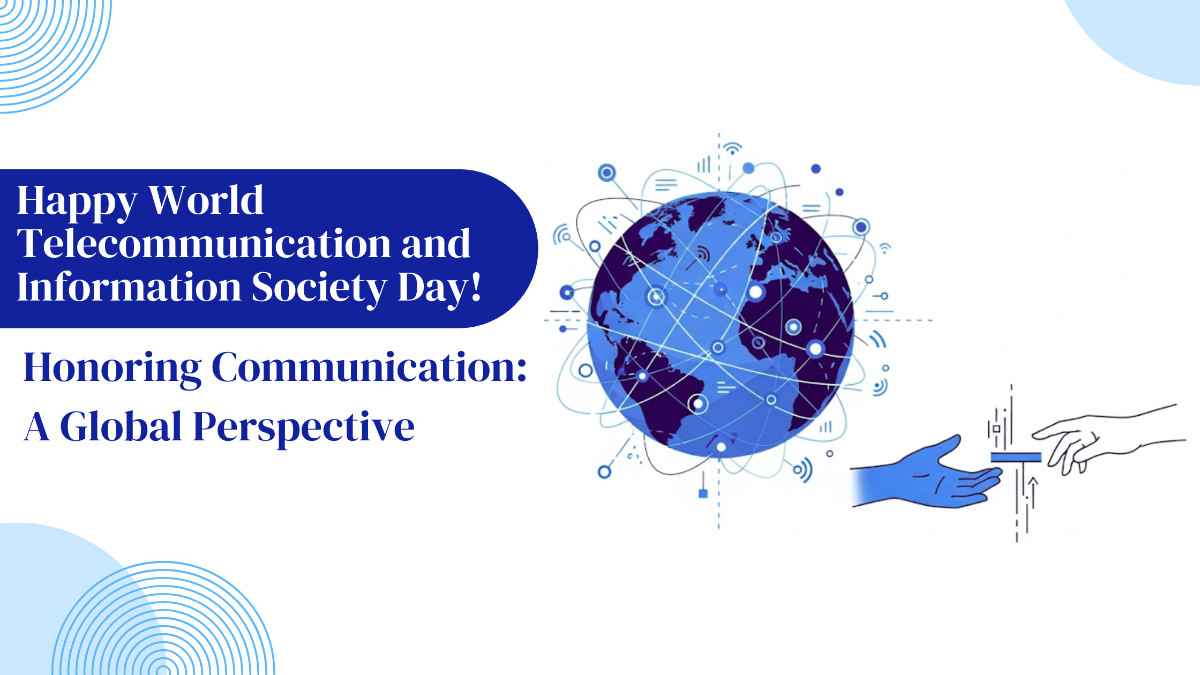
World Telecommunication and Information Society Day (WTISD) is observed every year on May 17 to raise awareness of the transformative role that information and communication technologies (ICT) play in connecting societies, driving economies, and bridging inequality. Established by the International Telecommunication Union (ITU), the day has grown from a telecommunications commemoration into a global conversation about digital equity, resilience, and the kind of connected world we want to build.
In 2026, that conversation is more urgent than ever. As digital infrastructure becomes inseparable from how communities function, the emphasis shifts from simple access to genuine resilience: networks that hold up during crises, systems that reach everyone, and communities that can thrive online regardless of geography or circumstance.
What Is World Telecommunication and Information Society Day?
WTISD is an annual United Nations observance on May 17. Its purpose is to raise awareness of the possibilities that the internet and ICT can bring to societies and economies, and to highlight ongoing efforts to bridge the digital divide. Each year, the ITU announces a specific theme that focuses global attention on a particular challenge or opportunity within the digital landscape.
The day marks the anniversary of the signing of the first International Telegraph Convention in Paris on May 17, 1865, which also led to the founding of the ITU. It has been observed annually since 1969, formally instituted at the ITU Plenipotentiary Conference in Malaga-Torremolinos in 1973.
Key fact: In November 2006, the ITU Plenipotentiary Conference in Antalya, Turkey, combined World Telecommunication Day with World Information Society Day into a single observance called World Telecommunication and Information Society Day (WTISD), to reflect the growing importance of the internet and digital technologies alongside traditional telecommunications.
A Brief History of WTISD
The International Telegraph Convention
The first International Telegraph Convention was signed in Paris on May 17, 1865, bringing together 20 European nations to coordinate telegraph networks. This event also led to the creation of the International Telegraph Union, the organisation that would later become the ITU.
Renamed the International Telecommunication Union
As the organisation expanded its responsibilities beyond telegraph to radio and telephone, it adopted the name International Telecommunication Union, reflecting its broader mandate over all communications technologies.
ITU Becomes a UN Specialised Agency
The ITU was formally established as a specialised agency of the United Nations, positioning it as the central global authority for managing information and communication technology issues.
First World Telecommunication Day
May 17 was first celebrated as World Telecommunication Day to mark the ITU’s founding and draw attention to the role of telecommunications in global development.
WTISD is Born
Following the 2005 World Summit on the Information Society, the UN General Assembly declared May 17 as World Information Society Day. Later that year, the ITU merged both observances into World Telecommunication and Information Society Day (WTISD), recognising that telecommunications and digital inclusion were inseparable issues.
WTISD 2026 Theme: Digital Lifelines
The 2026 theme, “Digital lifelines: Strengthening resilience in a connected world,” marks a meaningful shift in focus. Previous themes addressed innovation, sustainable development, and digital inclusion. In 2026, the ITU turns attention to a foundational question: what happens when the networks we depend on fail?
Digital lifelines refers to the infrastructure that keeps communities functioning: terrestrial networks, submarine cables, satellites, and data systems. The theme calls on governments, industry, and communities to design systems that can withstand shocks and recover quickly, ensuring that no person or community is cut off when it matters most.
Terrestrial Networks
The fibre and copper cables, towers, and local infrastructure that carry most of the world’s internet traffic. Resilience here means redundancy, backup routing, and faster repair cycles.
Submarine Cables
Over 95% of international internet traffic travels through undersea cables. Protecting and repairing these cables is a global priority for uninterrupted connectivity between continents.
Satellite Networks
Low-Earth orbit satellite constellations are increasingly providing connectivity to remote and underserved areas where terrestrial infrastructure is impractical or absent.
Data Systems
Cloud infrastructure, data centres, and the software systems that run them. Resilience means distributed architecture, cybersecurity, and disaster recovery planning at scale.
WTISD Annual Themes: 2020 to 2026
| Year | Theme |
|---|---|
| 2020 | Connect 2030: ICTs for the Sustainable Development Goals |
| 2021 | Accelerating Digital Transformation in Challenging Times |
| 2022 | Digital Technologies for Older Persons and Healthy Ageing |
| 2023 | Empowering the Least Developed Countries through ICTs |
| 2024 | Digital Innovation for Sustainable Development |
| 2025 | Digital Gender Equality |
| 2026 | Digital lifelines: Strengthening resilience in a connected world |
Why Digital Resilience Matters in 2026
The COVID-19 pandemic made the consequences of digital fragility impossible to ignore. Those with stable internet access shifted to remote work and digital learning within days. Those without it faced a compounding disadvantage: economic, educational, and social. That moment demonstrated that connectivity is not a luxury. It is infrastructure in the same category as water, electricity, and transport.
In the years since, new vulnerabilities have emerged. Undersea cable disruptions have severed connectivity to entire regions. Cyberattacks on critical infrastructure have exposed the fragility of systems assumed to be robust. And for the estimated 2.6 billion people still unconnected, “digital resilience” is not yet a concern because basic access has not arrived at all.
The digital gender gap: Of the 2.6 billion people still unconnected globally, the majority are women and girls. Bridging the digital divide requires addressing not just infrastructure but affordability, digital literacy, and cultural barriers that disproportionately affect women in developing countries. This was also a key focus of the 2025 WTISD theme on Digital Gender Equality.
The shift from “digital innovation” (2024) to “digital lifelines” (2026) signals a maturing conversation. Building new technology is not enough. The world now needs to ensure that the technology already built is reliable, equitable, and capable of withstanding the disruptions that will inevitably come.
Understanding the Information Society
An information society is one where information creation, dissemination, and access are central to economic, political, and cultural life. Unlike the industrial age that preceded it, the information age is defined by connectivity: access to knowledge, to networks, and to digital services that were previously inaccessible to most of the world’s population.
Building a genuine information society requires more than fast internet. It depends on four interconnected foundations:
Affordable Access to Devices and Data
Even where networks exist, the cost of smartphones and data plans remains a barrier for a significant portion of the global population. Affordable access is the entry point to everything else.
Digital Literacy and Skills
Access without the ability to use it effectively creates very little value. Digital literacy programmes, particularly for older adults and rural populations, are essential for meaningful participation in the information society.
Locally Relevant and Multilingual Content
A significant portion of online content is in a small number of dominant languages. Creating and amplifying content in local languages and cultural contexts makes the information society genuinely inclusive.
Secure and Trustworthy Platforms
People will not fully participate in digital life if they do not trust the platforms they use. Data privacy, cybersecurity, and platform accountability are foundational to an inclusive information society.
Digital Communities and the WTISD 2026 Vision
The 2026 theme of digital resilience is not only about physical infrastructure. It is equally about the human networks that digital technology enables and the institutional communities that are built and sustained online.
For schools, universities, and organisations, building a resilient digital community means investing in platforms and practices that keep people connected across time, geography, and circumstance. An alumni engagement management platform is one clear example: it creates a persistent digital connection between an institution and its graduates that does not depend on proximity, printed newsletters, or in-person events.
The shift toward online alumni engagement reflects the same principle that WTISD 2026 champions at a global scale: that meaningful, resilient connection requires intentional digital infrastructure, not just a social media group or an email list. Communities built on purpose-built platforms are more discoverable, more measurable, and more durable than those relying on borrowed infrastructure.
The debate between alumni apps versus community websites mirrors the same infrastructure conversation happening in global telecommunications: not which technology is newest, but which combination of tools creates the most resilient, accessible, and sustained connection for the community it serves.
Multi-Channel Communication
Resilient digital communities do not rely on a single channel. Push notifications, email, SMS, and in-app messaging together ensure that important communications reach members regardless of how they interact with the platform. This is the community-level equivalent of network redundancy.
Cross-Device and Bandwidth Accessibility
A platform built only for high-speed broadband excludes the members who need it most. Digital alumni engagement tools designed to work across devices and bandwidth conditions reflect the ITU’s principle that connectivity should serve everyone, not just those already well-connected.
Persistent Digital Identity
A digital alumni card with a scannable QR code gives alumni a lasting, verifiable digital identity tied to their institution. It works online and offline, bridging the gap between physical presence and digital access in the same way that digital lifelines bridge connectivity gaps in underserved regions.
Data-Driven, Personalised Engagement
Digital resilience is not just about infrastructure staying up. It is about communities remaining relevant and active over time. Alumni engagement tools that use data to personalise communication ensure that members continue to see value in their digital community, sustaining participation across years and generations.
“Radio links, submarine cables, and surface networks form a dense network around the Earth that is now extending to the stars. These links are such a part of our daily lives that it is impossible to imagine that one day they might fail us.”ITU President, 1969, at the launch of World Telecommunication Day
How Institutions Can Mark WTISD 2026
For schools, colleges, and organisations, May 17 is an opportunity to align their digital engagement work with a global conversation and demonstrate their commitment to connected, inclusive communities.
Run a Digital Literacy Workshop
Organise a session for students, staff, or alumni on a practical digital skill: cybersecurity basics, using AI tools responsibly, or navigating digital platforms for professional networking.
Host a Webinar on Digital Inclusion
Invite faculty, alumni working in tech or policy, or external speakers to discuss the 2026 theme of digital resilience and what it means for communities in your region.
Launch or Showcase Your Digital Community
Use May 17 as an occasion to officially launch, relaunch, or draw attention to your institution’s online alumni or student community platform. Frame it as part of your commitment to building lasting digital connections.
Share Stories of Digital Transformation
Post alumni stories of how digital tools have changed their careers or communities. These stories make the global theme personal, relatable, and shareable across your institution’s social channels.
Frequently Asked Questions